If there'due south an occupation that is 100% linked with the public'south thought of what design is all nigh, it'south graphic pattern. From the familiar golden arches of the McDonald's make to the typography and colors of picture show posters, graphic designers create some of the most iconic and ubiquitous designs effectually us. So why would a graphic designer like you lot desire to change your career to UX design? Well, for one, much tin can be said near the sense of satisfaction and fulfillment derived from getting "under the hood" of the products you piece of work on rather than working on the outside. Furthermore, co-ordinate to PayScale, the average salary for a graphic designer in the United states is $41,000(1), merely the aforementioned for a UX designer is a whopping $74,000(two).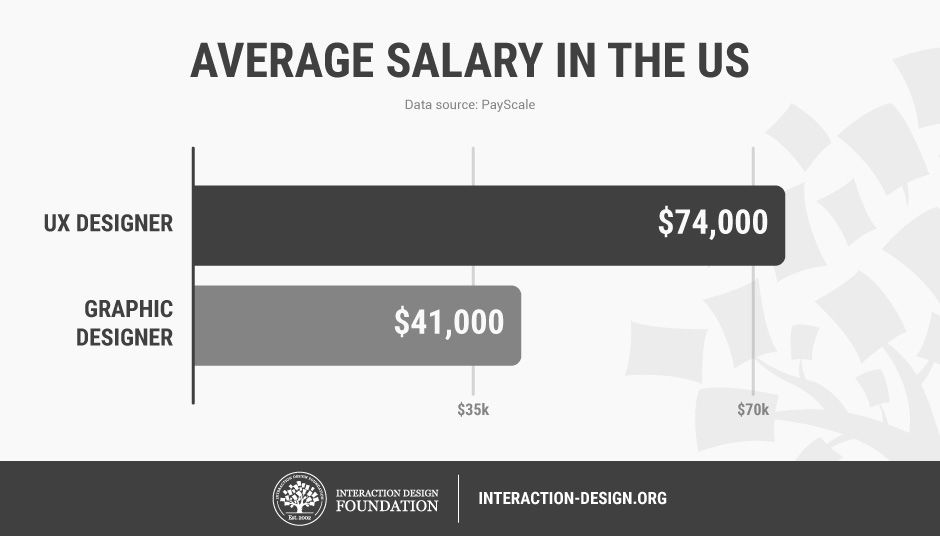 Whatever the reason for the move, information technology's clear that information technology can be a very rewarding one. Simply how do yous go almost switching from graphic blueprint to UX design? Let's find out.
What is User Feel and User Experience Blueprint?
The user experience (UX) is what a user of a particular production experiences when using that product. A UX designer's job is thus to create a product that provides the all-time possible user experience. How does that happen?
Well, it starts with a lot of research. Y'all can't create anything of value to a user unless you understand what kind of problems they want to solve and how you can solve those problems, and so that the user volition want—or improve yet, demand—your solution. Yous can merely get that understanding past interacting with users.
UX designers tend to be concerned with, as you tin see from the epitome beneath, three master factors: the look of a product, the feel of that production and the usability of that product.
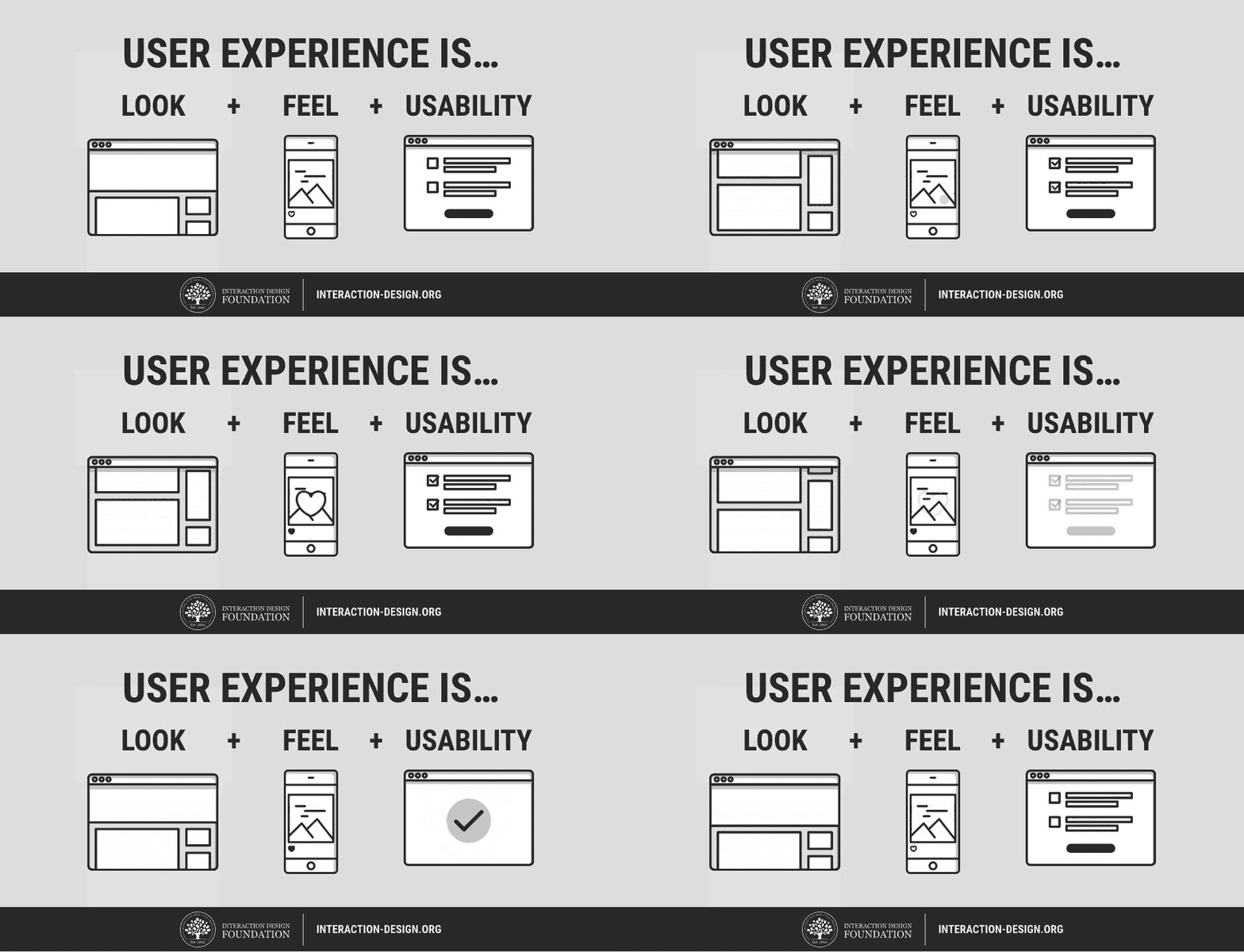
The look of a production is all about creating a product that has visual appeal and which, in particular, harmonizes with a user's values and captures the spirit of what they look in that product. In other words, it has to not but look nice, but look right besides. In doing then, it establishes a bond of trust and credibility between the production and the user.
Next is the feel, which is actually about developing products that are "a joy to employ". That is, whether you're interacting with them or reacting to them, products should provide a pleasurable experience and not just a functional i.
Lastly, usability is the cornerstone of user experience. If a product isn't usable, the experience of using information technology can never be skilful. UX designers want to create products which can, ideally, be tailored to meet a user'south specific needs, but which provides functionality that is predictable.
If you're all the same unsure of what UX blueprint is all about, don't worry! We've got a series of articles which may aid you make up your heed—they examine some of the loftier-level key concepts of UX design in a fleck more than particular than we can hither:
An Introduction to Usability
Usability vs Desirability
What is Interaction Pattern?
What Do Graphic Blueprint and UX Design Accept in Common?
Emotional Design
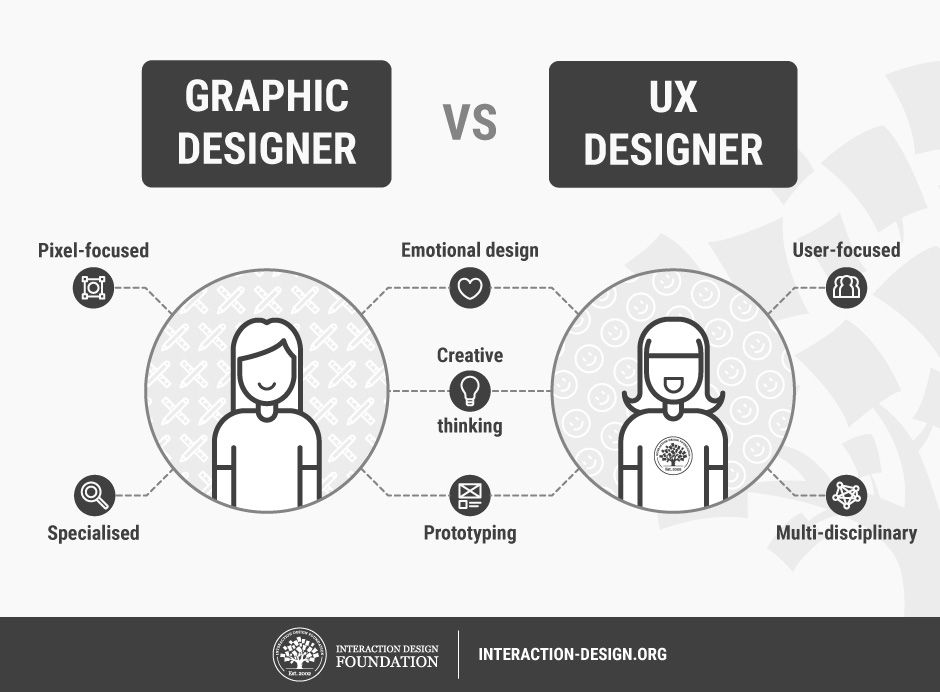
Graphic design is about emotional communication through typography, colour and images; serif fonts and dark, duller colors evoke seriousness, while san-serif fonts and bright colors tend to bring out a sense of joy or excitement. Graphic designers are hence very often emotional designers who elicit specific reactions in a user. UX blueprint is also concerned with shaping the emotions of the user, although information technology tends to have a broader, big picture view of the entire user's experience with the product. On top of focusing on the right typography and colors, UX designers are also concerned with motility blueprint, the tone of the content, and information architecture, among others.
Creative thinking
Graphic designers and UX designers are both every bit skilled at creative thinking. For graphic designers, creating visuals that adhere to conventions (and thus communicate effectively) while retaining a sense of originality (to stand out among the competition) requires some serious creative and disquisitional thinking. In the same way, UX designers take to create products that solve users' issues—and sometimes, conventional solutions aren't e'er the best or nigh appropriate ones.
Prototyping
Graphic designers frequently create mockups and wireframes of their designs prior to delivering a finished design. It gives a chance for clients to offering feedback on their designs and for them to better them without having to get-go from scratch. UX designers create mockups and prototypes as well, but these tend to be less focused on the "expect" of the product and more on the "experience" of it. Is the epitome useful? Is information technology usable? Is it desirable? These are the questions a UX designer wants answers to.
The Differences between Graphic Pattern and UX Design
User-focused vs pixel-focused
Graphic designers tend to pursue pixel perfection in their designs. Ensuring that texts accept perfect kerning and colors conform to brand guidelines often take up a pregnant portion of graphic designers' jobs—and for adept reason, also. UX designers, however, are primarily focused on users. They written report the interface between users and the product, finding means to ensure that the production answers to the user's key needs. And they do so by conducting a lot of research—by talking to and observing users, creating user personas and stories, doing usability testing on the products, and many more than. Graphic designers looking to switch career tracks volition need to do a substantial amount of work finding out how to conduct user inquiry (more about this a bit afterward in the article).
Iterative trouble solving
UX design is very much an iterative problem solving process, and information technology can be very dissimilar from what you're used to doing as a graphic designer. It begins with the identification of a problem; this is often establish through user enquiry, and if it'due south not, it volition then exist confirmed through user research. There is no betoken in solving problems that users don't care most; they won't pay to solve those bug, and that ways your company won't make money.
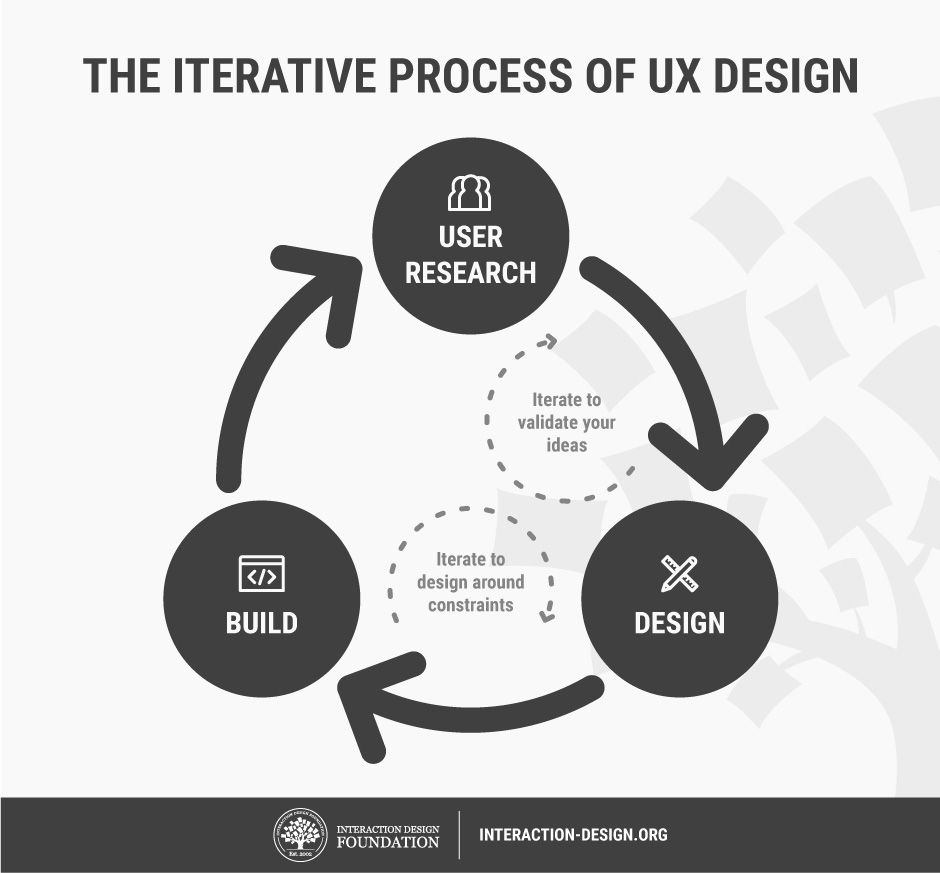
From the problem identification phase, more than research is conducted into how best to solve the problem in a way that the user volition be happy with—commonly via observations, surveys, ethnographic studies, etc.
This research then informs the product'south pattern. Designs are then tested with users to see if the research led to the correct solutions. The designs are constantly iterated until enquiry confirms that they are good enough.
Once this happens the production is launched, only the pattern process is non over. The design will exist continually tested and user feedback will be taken, thus beginning a new round of user research. Future improvements to the design volition exist fabricated based on this feedback.
Multi-disciplinary vs specialized
Graphic design is a specialized field of study, and there is a certain level of craftsmanship and set of specialized skills (such as typography and colour theory) required to produce great visuals. UX design, on the other manus, is much more than multi-disciplinary and involves many schools of knowledge. UX designers have to constantly larn nearly homo psychology, interaction design, data compages and user enquiry techniques, just to proper name a few, in club to create the right solutions to a user's issues. Don Norman, the homo who coined the term "User Feel", explains that user feel covers "all aspects of the person's feel with the organisation including industrial design graphics, the interface, the physical interaction and the manual."
The Large Benefit of Graphic Blueprint Experience when Moving to UX Blueprint
Aesthetics
The biggest benefit for graphic designers moving to UX design is that they can make things attractive. A very common misconception about UX design is that skillful usability trumps aesthetics. On the contrary, good aesthetics accept been institute to better the overall user experience of production—by making users more relaxed, creating a positive first impression, and by and large merely showing that you lot care(three).
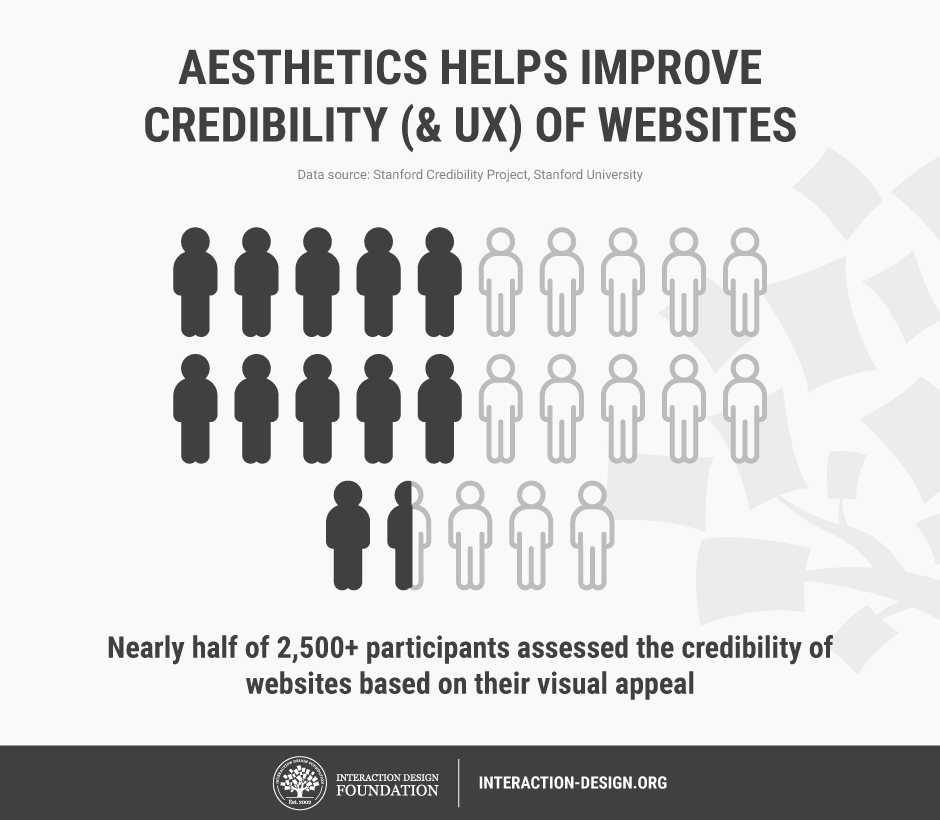
Aesthetics likewise help designers communicate with the internal stakeholders in their companies. Ex-graphic designers can present research results in a way that makes stakeholders sit down upwardly and really have detect. Graphic design skills are oftentimes thought of as optional in UX research, but information technology would be hard to deny the affect of well-presented beautiful findings. If you do make the change, you lot'll need to rest your tendency to brand things gorgeous with the need for moving your design projects forward. There are times in UX blueprint when a few scribbles on the back of a napkin are more than enough to get things going; don't spend 3 days producing a poster when this is the case.
Conventions and trends
Coming from a design background not simply ways having a good grip on design terminology, simply as well that you're likely to be familiar with the conventions and trends in web or app designs. Most times, UX designers make use of standardized conventions (like a toggle switch for on/off states, dropdown listing for multiple options, etc.) because users accept come to look these interactions on a website. Graphic designers—especially if you've created prototypes in the past—are also familiar with such conventions. That means yous'll conform more than quickly to a UX design office than someone who comes from a non-pattern background. This might not sound similar much, but communication is the core of whatsoever UX pattern project and being able to talk-the-talk is a large benefit.
How to Raise Your Skills to Make the Jump from Graphic Design to UX Design
Is there a gap between graphic design skills and UX design skills? Yes, but it's not an insurmountable ane. Graphic designers already speak the language of design; they just need to brush upwards their skills to include those that are unique to UX design.
Once you have those skills, you can first to piece of work them into your graphic design work (because user experience design tin can inform graphic pattern just equally much as information technology can inform production design) and kickoff to tailor your CV to highlight your UX skills as well as your graphic design skills.
As we mentioned higher up, the real key for graphic designers is to sympathise user enquiry in all its forms. All the courses nosotros've highlighted below should accost this need to a greater extent.
Online Courses
Interaction Design Foundation
We'd like to modestly present our ain course offerings for this, equally the Interaction Design Foundation is the world's largest specialist design education customs. Don Norman, the aforementioned man who coined the term "User Experience" and who is ane of the earth's all-time known designers, says that we're "a goldmine of information on interaction blueprint"; Forbes magazine says we supply an Ivy League level of UX design education!
There are iii courses that we have put together specifically with a career change or first chore in UX pattern in mind. In Become a UX Designer from Scratch, you lot'll be introduced to all areas of UX work, learn basic practical skills to carry UX piece of work, and gain the conviction to work with UX clients as a consultant. In Get Your Starting time Task as a UX (or Interaction) Designer, y'all'll find out how to get the experience in UX that prospective employers are looking for, acquire to develop a winning cover letter of the alphabet, CV and portfolio to go a UX interview, and negotiate a job offer. And in User Research – Methods and Best Practices, you'll learn the various methods of conducting user research, and so putting the research results into action.
We likewise offer a bunch of other courses (32, and constantly growing!) to aid you further develop your skills in UX design. The good news is that with a low annual fee, yous go access to all of our courses for a year with no additional charges, and you lot get admission to our community too.
You can find out nigh our other courses here.
Coursera
You might also want to endeavor the folks at Coursera.org, which is a low-toll merely high-quality pedagogy provider which delivers courses on a broad range of subjects including UX. It does partner with universities and companies to offering courses, Professional person Certificates, and degrees, and courses are generally very skillful. All content on the platform, with the exception of degrees, is bachelor on demand. It's besides worth noting that their caste programs are just bachelor for new applications during set windows. They also recently launched a Google UX Blueprint Professional Document to aid learners build job-ready skills in nether six months.
Udemy
Udemy is the globe's biggest broker of training. They don't design their own training; rather, they enable grade creators to sell their courses on their platform. They offer literally thousands of courses in virtually any believable subject. The trouble is that Udemy provides no quality control, and while you can find some smashing courses in that location, there are a lot of not so corking courses besides.
Classroom Courses
Nielsen Norman Grouping
If you lot accept deeper pockets and would prefer to learn in a classroom than larn online, then you might want to check out the classroom courses offered by the Nielsen Norman Group. The group has an excellent reputation and is i of the earth's about respected UX consultancies. They offer their courses in a range of locations, but we tin't guarantee that you'll discover 1 on your doorstep and you may have to travel some distance to take part in them.
General Assembly
We also retrieve that General Assembly has a nifty reputation for providing immersive classroom training for UX design. One time once more, it's not cheap but that is always going to be true of professional classroom training. Yous can choose between function-fourth dimension or full-time courses. Every bit they're brusk, they echo every few months. They are, all the same, available only at select locations, and you'll demand to factor travel and living expenses into the total cost, in instance you don't live nearby.
University Courses
We're not sure that academy is the best option for those seeking a change of career direction; it's non merely the money required, only as well the time taken. Y'all could exist earning and learning using a unlike method rather than spending 3 or 4 years on a bachelor'due south degree or 2 years on a Primary's program. However, if y'all do make up one's mind to go the university road, you lot'll desire to spend a lot of fourth dimension researching exactly the correct program for you. Nosotros've got a couple of examples for y'all here but there are literally hundreds of programs globally and nosotros couldn't promise to cover them all.
Carnegie Mellon – HCI Programs
York Academy – MSc in HCI Technologies
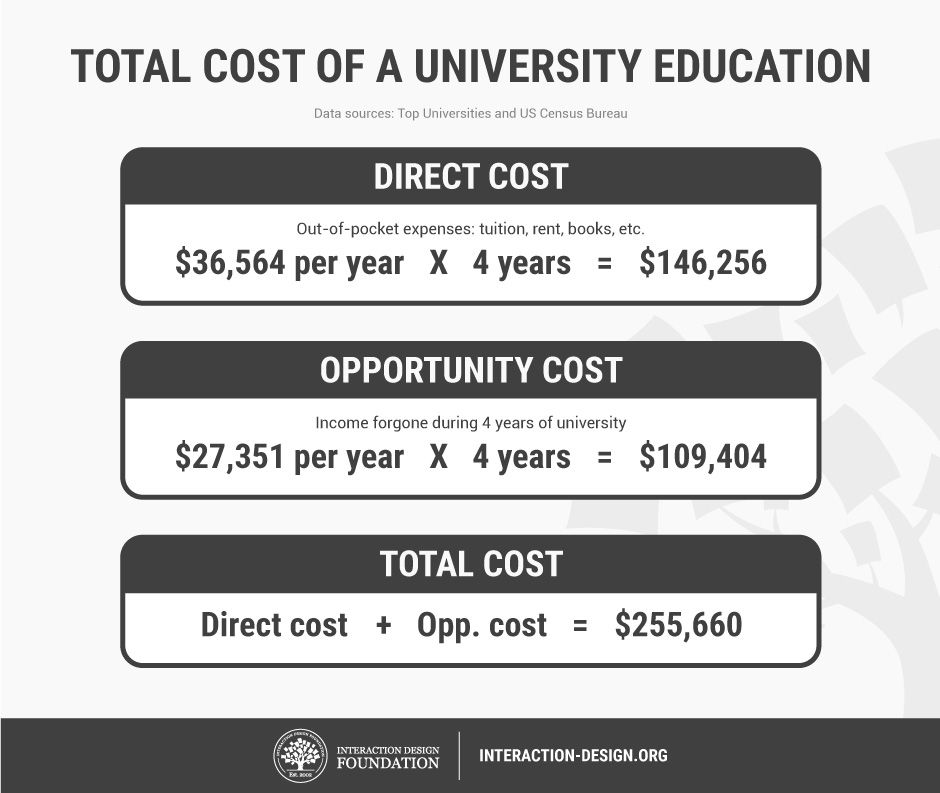
We'd urge that you lot sit downwards with a calculator and think about the costs associated with going to university before booking a place. HSBC, as reported by Top Universities, found that the boilerplate US academy class volition cost you $36,564 a year (including hire, tuition, books, etc.). (4) Over a 4-year degree, that means shelling out a cool $146,256—and that's without the costs of a loan to embrace those expenses.
But that's not all—you lot'll also accept to give upwards total-fourth dimension work. According to the United states Census Bureau, a non-graduate earns an boilerplate of $27,351 per year.(5) This gives u.s. a four-year opportunity cost (that is, the income that yous've forgone while in university) of $109,404. That means 4 years at university will prepare you lot back a huge $255,660!
If you lot don't know which kind of learning to invest in, that's OK. We know it tin can be confusing trying to work out what will add the most value to your career. With that in mind, nosotros've put together a piece that walks you through calculating the Return on Investment in learning hither; hopefully that will help you determine what's correct for yous.
Networking
Once yous've brushed up your skillset and you feel you lot're set up for that first UX function, y'all might observe handy to do some networking. The best opportunities are almost e'er found when someone already in the field recommends you lot for a position. One of the best places to start with your networking is LinkedIn. Join some UX groups, showtime contributing, and build that all of import network with your peers. But take it slow; don't just show upward and beginning asking for a task. Y'all need relationships with people earlier they will help.
We too offer some awesome networking opportunities to both our members and non-members too. Members tin can bring together our global community of UX professionals in the many word groups and forums that we provide; we have the largest specialist blueprint community on earth then there are enough of opportunities to be uncovered there. For members and non-members, we also have local group meetings in many places around the planet. These meetings are completely free to attend and are a great way to meet people doing UX in your home boondocks or city. Find out more at our Community page.
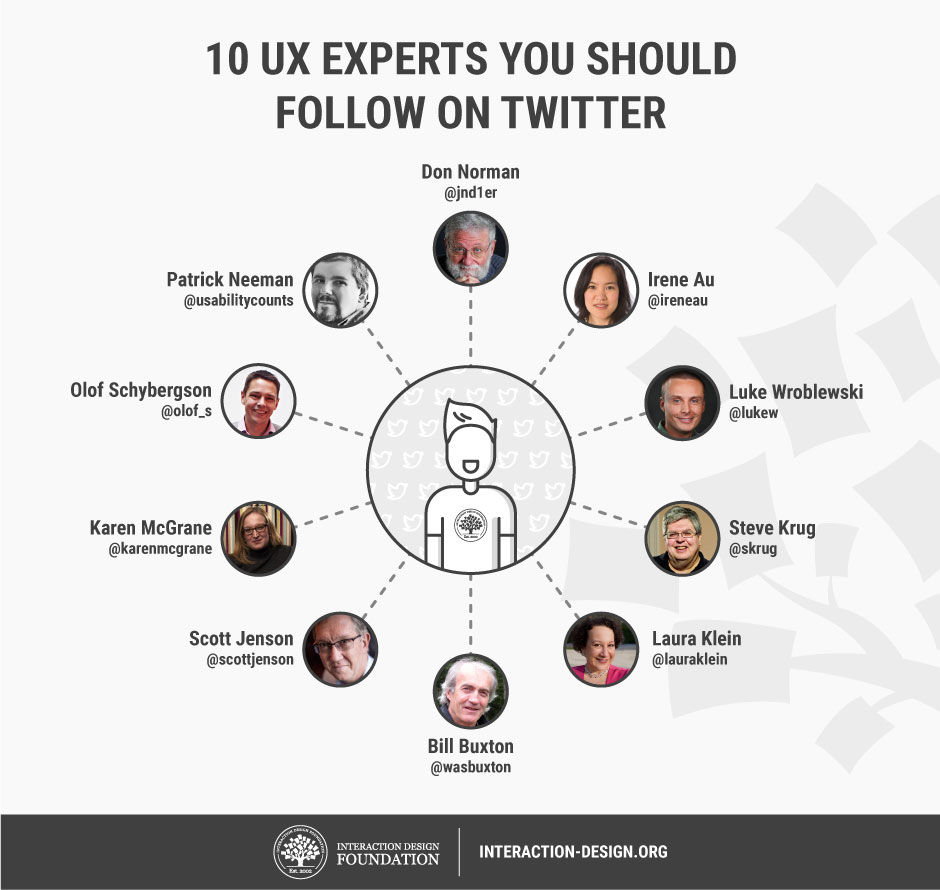
Ane other useful manner to start networking is to follow famous members of the UX blueprint community on Twitter. Not only will you lot learn a lot from them, yous can also interact with their followers (who are likely to exist designers similar you too). We've put together a list of 20 people you should follow on Twitter in the UX sphere here to get your started.
Mentoring and Feedback
Another great style to develop your career is to work with a mentor in the UX field who has "been there, done it and bought the t-shirt", at least then to speak. You may find a mentor through your own network nd that'south an awesome style to connect with a mentor, but if y'all tin't then our IxDF Blueprint League members can admission our network of design mentors as part of their annual membership fee.
The Accept Away
If you want to change from graphic pattern to UX blueprint as a career, that's awesome. It's non going to be equally difficult as y'all might think either. You just demand to go a niggling preparation under your belt so that you're familiar with what it is a UX designer does, then you lot can put some of those techniques to work in your current function. And then when you lot think the time is right, yous can start networking and lining up some interviews for your new job!
References & Where to Larn More
-
Payscale'south research on Graphic Design salaries - http://www.payscale.com/research/U.s./Job=Graphic_Designer/Salary
-
Payscale's inquiry on UX Blueprint salaries - http://www.payscale.com/research/United states of america/Chore=UX_Designer/Salary
-
UX Myths: Aesthetics are not important if you have practiced usability - http://uxmyths.com/post/1161244116/myth-25-aesthetics-are-not-important-if-you-accept-good-u.s.
-
How much does it toll to study in the The states - http://world wide web.topuniversities.com/student-info/student-finance/how-much-does-information technology-toll-study-united states of america
-
Earnings past didactics: Us Agency Of Labor Statistics - https://www.bls.gov/emp/nautical chart-unemployment-earnings-education.htm
DOWNLOAD HERE
Posted by: brittwaress.blogspot.com


0 Komentar
Post a Comment